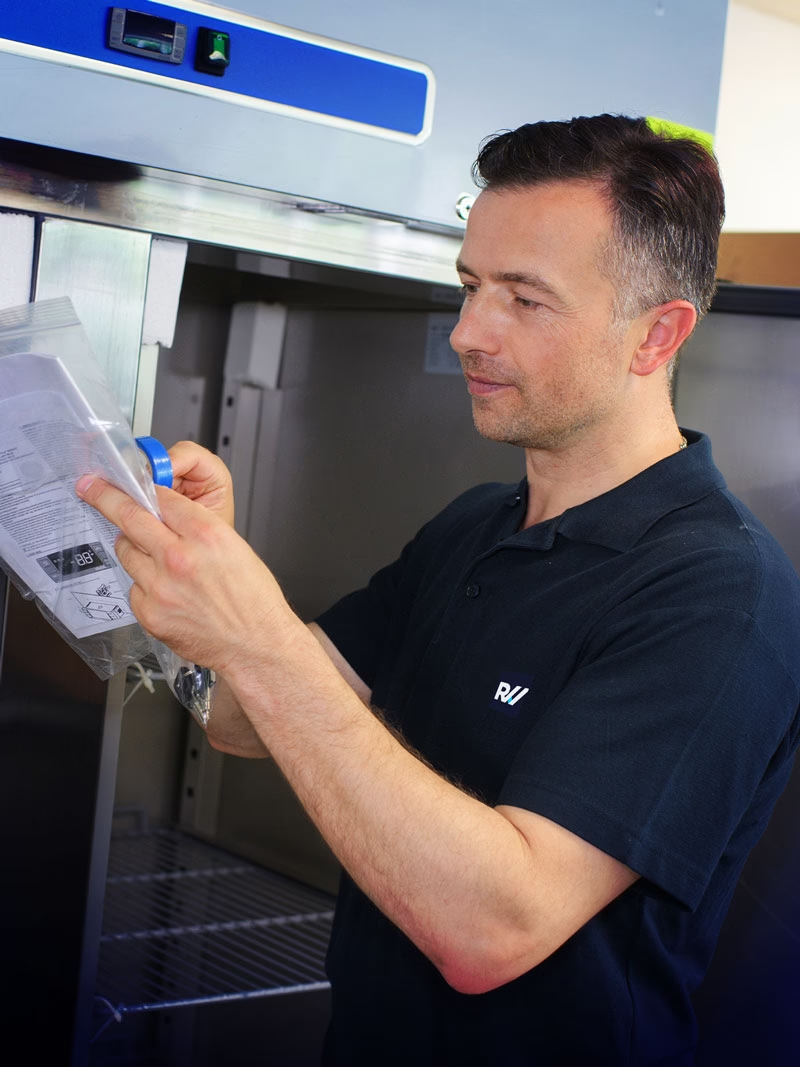
What are F gases, and are they in your kitchen fridges?
F gases (fluorinated greenhouse gases) include the hydrofluorocarbons, or HFCs, used as refrigerants in commercial refrigeration. Each has a global warming potential (GWP), which compares its effect on global warming with carbon dioxide. HFC 404A, which GOV.UK says is used in medium and large commercial refrigeration systems, has a GWP of 3,922. HFC 134a has a GWP of 1,430.
The equipment label tells you what is inside. Equipment containing regulated F gas must be labelled with the name of the gas, the amount in kilograms, the amount in tonnes of carbon dioxide equivalent and its GWP.
These are the rules for Great Britain. We checked them against GOV.UK guidance from Defra and the Environment Agency on 18 November 2026.
Who is responsible for F-gas leak checks?
The business that uses the equipment. GOV.UK says that if you use stationary refrigeration, you are responsible for getting it checked for F gas leaks. If your fridges are rented, read the agreement: the rental company may be responsible for leak checks instead. Responsibility for stopping leaks is shared between the users of the equipment and the technicians who install, maintain or dispose of it.
Which fridges and freezers need a leak check, and how often?
It depends on how much F gas the equipment holds and its GWP, measured together in tonnes of carbon dioxide equivalent. To work it out, multiply the charge in kilograms by the GWP and divide by 1,000: 10 kg of HFC 404A, for example, is 39.2 tonnes.
| Carbon dioxide equivalent (tonnes) | Leak check | Same as HFC 404A | Same as HFC 134a |
|---|---|---|---|
| 5 to less than 50 | At least every 12 months | 1.3 kg | 3.5 kg |
| 50 to less than 500 | At least every 6 months | 13 kg | 35 kg |
| 500 or more | An automatic leak detection system is required, and must itself be checked every year | 127 kg | 350 kg |
- Hermetically sealed systems below 10 tonnes (2.6 kg of HFC 404A or 7 kg of HFC 134a) have no maximum interval between leak checks. Equipment is labelled hermetically sealed when the part holding the F gas is permanently sealed, for example welded or brazed shut.
- Automatic leak detection doubles the time allowed between checks, so equipment at 5 tonnes needs a check every 2 years.
- If a check finds a leak, it must be repaired as soon as possible and checked again within a month.
Not having the required leak checks, or not fixing leaks, is against the law and can bring a civil penalty.
What F-gas records do you need to keep?
For equipment holding F gas equivalent to 5 tonnes of carbon dioxide or more, keep these records for 5 years:
- the quantity and type of F gas in the equipment when it was installed;
- the quantity and type added during maintenance, for example after a leak repair;
- the dates and results of all mandatory leak checks;
- how gas was recovered and disposed of, including the registered waste carrier used;
- the name, address and certificate number of any company that installs, services or decommissions the equipment.
Who is allowed to work on F-gas refrigeration?
Check two things:
- The company. A business, sole traders included, that installs, repairs, maintains or decommissions refrigeration containing F gas for other businesses must be certified by an approved body, and renew that certification every 3 years. GOV.UK lists three certification bodies for refrigeration: Refcom Certification Ltd, F-Gas Register (Quidos) and Bureau Veritas.
- The engineer. Everyone who works with F gas needs a personal qualification, even if they work for someone else. A category 1 certificate covers all refrigeration work, while a category 4 certificate covers leak checks that do not break into the refrigeration circuit.
Recovering the refrigerant from a fridge at the end of its life is also work for a qualified technician, and releasing F gas into the air on purpose is against the law.
RW Commercial Catering Engineers holds REFCOM company certification, certificate number REF1019305.
Which refrigerants are banned in commercial fridges and freezers?
The bans cover new products placed on the market in Great Britain, plus refilling some larger existing systems:
- New hermetically sealed commercial fridges and freezers: HFCs with a GWP above 150 are banned.
- New stationary refrigeration equipment: HFCs with a GWP above 2,500 are banned, except in systems that cool products below minus 50°C.
- New multipack centralised systems for commercial use with a rated capacity of 40 kW or more: F gases with a GWP above 150 are banned, with an exception for the primary circuit of some cascade systems.
- Refilling: virgin F gas with a GWP above 2,500 must not be used to refill a system holding 40 tonnes of carbon dioxide equivalent or more, which for HFC 404A means 10.2 kg or more. Until 2030 such a system can be topped up with reclaimed or recycled gas. The other options are retrofilling with a lower GWP gas such as HFC 448A or HFC 449A, following the manufacturer’s recommendation, or replacing the system.
Behind the bans sits the HFC phase down: GOV.UK says the UK is cutting HFC use by 79% by 2030, compared with the average between 2009 and 2012. Defra consulted on a tighter schedule for Great Britain in late 2025, and in May 2026 confirmed it will not legislate in 2026 to change the phase down steps from 1 January 2027. Ask about the refrigerant and its GWP before you buy new refrigeration.