Is there a legal servicing interval for catering equipment?
For most equipment the law sets a duty to keep it safe rather than a date. The exceptions are F-gas leak checks on larger refrigeration systems and the yearly gas check in let accommodation. The rules that matter in a commercial kitchen:
- Gas appliances. Regulation 35 of the Gas Safety (Installation and Use) Regulations 1998 requires employers to keep gas appliances, pipework and flues at work in a safe condition. HSE’s catering guidance says servicing should follow the manufacturer’s recommendations, with annual inspections as a reasonable minimum. The record of that check is the CP42 gas safety certificate.
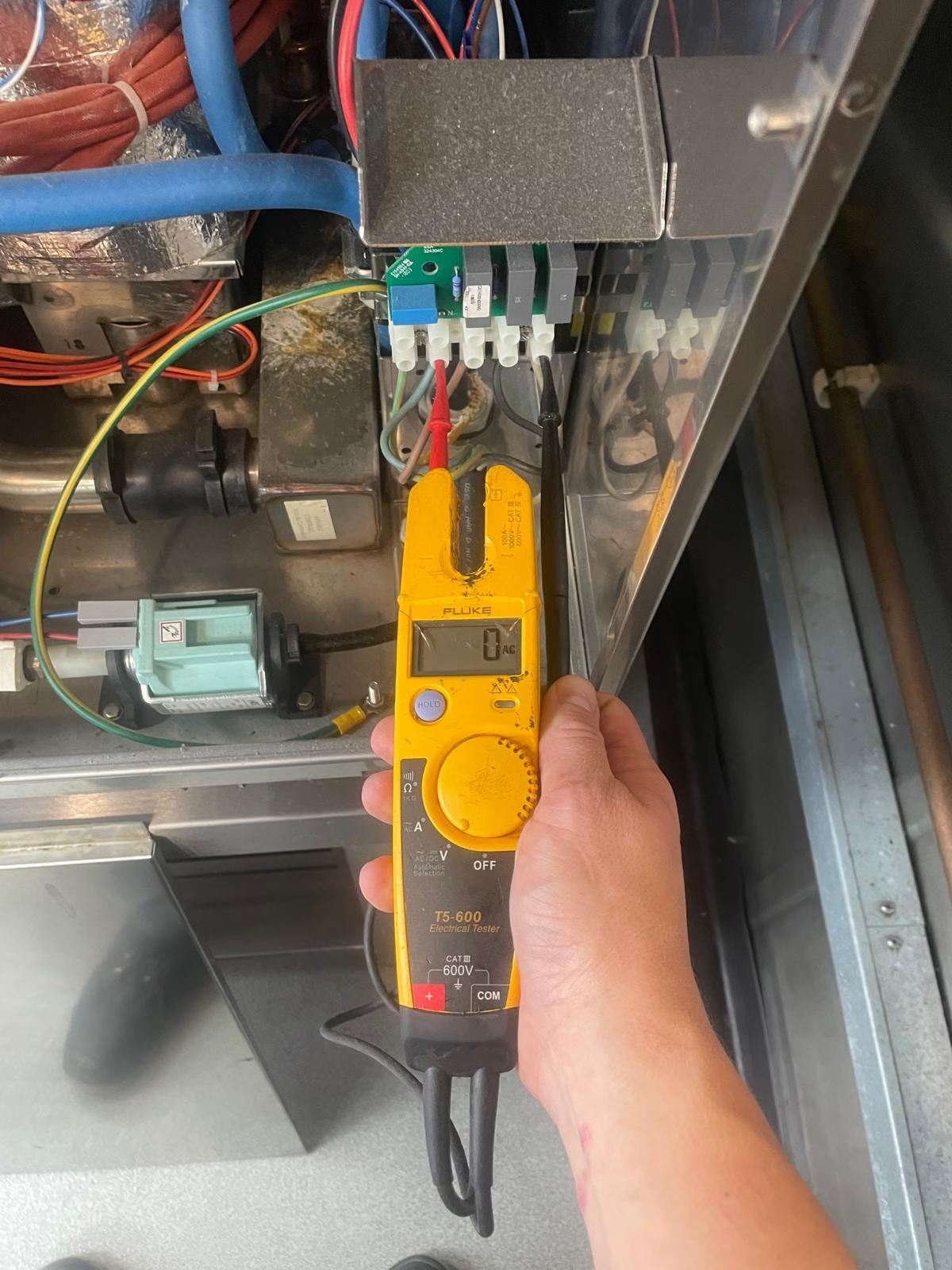
- Electrical equipment. The Electricity at Work Regulations 1989 require electrical equipment that could cause injury to be maintained in a safe condition. HSE is clear that they do not make yearly testing a legal requirement: how often depends on the equipment and how it is used.
- Refrigeration. Equipment holding F gas equivalent to 5 tonnes of carbon dioxide or more must be leak checked at least every 12 months, and every 6 months from 50 tonnes; from 500 tonnes an automatic leak detection system is required. Hermetically sealed systems below 10 tonnes have no maximum interval. A leak must be repaired as soon as possible and checked again within a month.
- Food safety. In England, chilled food must by law be kept at 8°C or below, and government guidance is to set fridges to 5°C or below. A fridge that cannot hold its temperature is a food safety problem as well as a repair.
How often should each type of equipment be serviced?
Your appliance’s manual sets the service interval, and Gas Safe Register notes that the longest most manufacturers allow is 12 months. In our experience the right frequency depends more on how hard the kitchen works than on the appliance, so our contracts run once a year, every six months or quarterly, and busy sites often choose the more frequent visits.
| Equipment | What a service covers | What sets the interval |
|---|---|---|
| Gas ranges, ovens, fryers, grills and gas combi ovens | Burners, venturis and pilots cleaned; soundness, working pressures, CO2 levels and flame picture tested; safety devices tested; CP42 issued | Gas safety duty, HSE’s yearly minimum and the manufacturer’s instructions |
| Electric ovens, combi ovens and fryers | Electrical safety checks; full function test; temperatures checked and calibrated; seals, doors and hinges checked | Electricity at Work Regulations (no fixed interval) and the manufacturer’s instructions |
| Fridges, freezers and cold rooms | Condensers cleaned; refrigeration pressures checked; door seals checked; temperatures verified | F-gas leak check interval where the charge requires one, food temperature limits and the manufacturer’s instructions |
| Ice machines | Full function test; panels removed to check for leaks, damage or corrosion; condenser cleaned | The manufacturer’s instructions, plus F-gas checks where they apply |
| Dishwashers and glasswashers | Electrical safety checks; full function test; temperatures checked; panels removed to check for leaks, damage or corrosion | Electricity at Work Regulations and the manufacturer’s instructions |
Three questions help decide between yearly, six-monthly and quarterly visits: how many hours a day the equipment runs, whether the kitchen could carry on if that appliance stopped, and what the manufacturer’s instructions say.
What are the signs your equipment is overdue a service?
- Gas flames that look wrong. Gas Safe Register’s warning signs include a floppy yellow flame instead of a crisp blue one and black or brown marks on or around the appliance. Stop using it and call a Gas Safe registered engineer.
- Fridges that struggle. A cabinet or cold room that runs all the time, ices up or will not hold 5°C. A condenser clogged with dust and grease cannot shed heat, so the compressor runs longer and uses more energy.
- Torn or loose door seals on fridges, freezers, ovens and dishwashers.
- Temperatures that drift. An oven or fryer that is slow to heat or does not match its setting, or a dishwasher that does not reach temperature.
- Water under a machine, tripping electrics, or scorched plugs and cables.
- Paperwork out of date. A last service report or CP42 more than 12 months old.
What does it cost to wait?
The cost of a missed service rarely shows up as a single bill. It arrives as:
- Equipment out of action. A gas appliance found At Risk or Immediately Dangerous is turned off or disconnected until it is repaired. HSE notes that these findings are unlikely where proper regular maintenance has been done.
- Food thrown away. Chilled food can be kept above 8°C for one period of up to 4 hours. After that it must be thrown away or chilled again and kept cold until it is used, so a fridge that fails overnight usually means lost stock.
- Enforcement. An environmental health officer will likely ask for evidence of gas maintenance and may serve a formal notice without it. An unsafe food business can get a low food hygiene rating, be closed or be prosecuted, and missing F-gas leak checks can bring a civil penalty.
- Higher running costs from refrigeration working harder than it should.
- Full-price call outs. Our contract customers get priority, with discounted call out and labour charges, when something breaks down between visits.